- All
- Product Name
- Product Keyword
- Product Model
- Product Summary
- Product Description
- Multi Field Search
- Home
- About Us
- Products
- Customer Services
- MEDICAL INFOR
- Contact Us

Views: 0 Author: Site Editor Publish Time: 2026-05-09 Origin: Site


The landscape of emergency vascular access has shifted dramatically over the past decade. While peripheral intravenous (PIV) cannulation remains the first-line approach, the reality is that up to 10-15% of critically ill patients present with failed peripheral access—a figure that climbs significantly in trauma, cardiac arrest, and hypovolemic shock scenarios. During the COVID-19 pandemic, many hospitals faced unprecedented challenges with difficult venous access in patients under personal protective equipment, leading to increased interest in intraosseous (IO) systems as reliable alternatives.
Procurement teams today face a complex decision when selecting an intraosseous device. The choice is no longer simply between manual and powered systems. The clinical consequences of selecting the wrong IO system can include delayed resuscitation, device failure at critical moments, infection at insertion sites, and even compartment syndrome from improper infusion. These outcomes directly impact patient survival and hospital liability.
This article examines the clinical, technical, and operational factors that drive procurement decisions for intraosseous access systems, providing a framework for evaluating the various io devices available in the market today.
The fundamental challenge of any intraosseous device lies in penetrating the highly dense cortical bone while avoiding posterior wall perforation. Clinical experience reveals that needles with poorly designed bevel geometries frequently fail in patients with osteopetrosis or severe osteoporosis—two populations that represent opposite ends of the bone density spectrum but are both challenging for IO insertion.
The ideal needle design incorporates a coring mechanism that clears bone fragments from the lumen during insertion. Devices without this feature are more likely to occlude, resulting in high-pressure alarms or failed flow rates when infusion begins. Procurement teams should evaluate whether a system uses a stylet that is retracted after insertion or one that requires manual clearing.
Current research suggests that bi-beveled needle tips with an optimal insertion angle of 45-60 degrees achieve first-pass success rates exceeding 90% in adult proximal tibia placements, compared to approximately 75% for standard bevel designs in the same anatomical location.
For a deeper analysis of common failure mechanisms, including needle obstruction and improper placement, see our article on why intraosseous access sometimes fails.
The debate between powered and manual intraosseous infusion systems centers on three core factors: insertion speed, operator fatigue, and user variability.
The EZ IO remains one of the most widely recognized powered systems, and for good reason. Its automated insertion mechanism delivers consistent penetration depth, reducing the risk of over-insertion. However, procurement teams should examine the power delivery mechanism—does the device use a constant-speed motor or a variable-speed trigger? Variable-speed triggers allow operators to modulate insertion force based on real-time tactile feedback, which is particularly valuable when encountering unexpected resistance from tibial tuberosity variations.
Manual systems, conversely, offer no dependency on batteries—a consideration for pre-hospital environments or facilities in regions with unstable power supply. The trade-off is significant: studies demonstrate that manual insertion failure rates can be 30-40% higher when performed by operators with less than five emergency IO placements in their clinical history. This operator-dependent variability makes manual systems a risky choice for facilities with rotating resident staff or infrequent IO utilization.
A direct head-to-head comparison of power versus manual devices in real emergency scenarios is available in our analysis: power vs. manual IO devices — which one performs better in emergency situations.
Guidelines recommend that an IO system should maintain flow rates of at least 80-125 mL/min for adult resuscitation fluids. While many devices claim higher flow rates, procurement teams must verify these under real-world conditions—specifically with high-viscosity fluids like blood products.
Tests conducted with packed red blood cells (hematocrit ~55%) often reveal that flow rates drop by 40-60% compared to crystalloid infusions. This variance is directly attributable to needle diameter and the presence of internal obstructions like bone fragments. Systems with 15G or larger needle diameters consistently outperform smaller-gauge alternatives for blood product administration.

Historically, IO access was reserved for cardiac arrest or profound shock. Current clinical consensus is expanding this paradigm. For patients with burns covering more than 30% total body surface area, where peripheral veins may be thrombosed or inaccessible, early IO placement can prevent delays in fluid resuscitation that worsen burn depth progression.
A controversial point: Some trauma centers are now advocating for routine IO placement in patients with suspected hypovolemic shock even before venous access attempts, arguing that the time spent attempting three or more PIV sticks could better be used initiating IO-driven resuscitation. This approach remains debated because it introduces infection risk and potential for osteomyelitis in patients who might otherwise have been successfully resuscitated via peripheral means.
Intraosseous access is increasingly recognized as a viable route for uncrossmatched blood administration in hemorrhagic shock. While the concept is not new, recent studies demonstrate that IO-infused packed red blood cells maintain normal morphology and oxygen-carrying capacity for up to 24 hours post-infusion, challenging earlier concerns about cellular damage from bone marrow pressure.
This finding has implications for hospitals with high trauma volumes. Procurement teams should consider whether their IO systems have been certified for blood product administration and whether the flow characteristics support rapid transfusion (≥1 unit in 10 minutes).
Compartment syndrome remains one of the most serious complications of IO infusion, occurring in approximately 0.5-1% of cases. The risk increases significantly when infusions continue beyond 4 hours in a single site or when high-flow rates are maintained without interrupting the limb.
What many procurement teams overlook is the relationship between needle design and extravasation risk. Needles with inadequate bone-penetration depth may leave the tip partially in soft tissue, leading to fluid tracking subcutaneously rather than into the medullary cavity. Systems with clearly marked depth markings (in 5mm increments) and audible or tactile confirmation of cortical penetration reduce this risk substantially.

Dimension | Adult | Pediatric | Elderly/Osteoporotic |
Needle Length | 25-45mm | 15-25mm | 25-30mm |
Insertion Force | Higher | Moderate (softer bone) | Lower (brittle risk) |
Preferred Site | Proximal tibia, humerus | Proximal tibia, distal femur | Proximal tibia (avoid sternum) |
Flow Rate Priority | High | High (smaller total volume) | Moderate (fluid sensitivity) |
A single system that accommodates all three populations requires multiple needle length options. Procurement teams should verify that their chosen vascular access device offers at least 3-4 needle sizes to cover neonatal to bariatric patients.
Factor | Powered (e.g., EZ IO) | Manual |
Insertion Time | 3-5 seconds | 15-30 seconds |
First-Pass Success (Experienced) | 95-98% | 85-90% |
First-Pass Success (Novice) | 90-95% | 60-70% |
Battery Dependence | Yes (2-4 hours runtime typical) | None |
Cost Per Device | Higher consumable cost | Lower per-unit cost |
Training Requirement | Moderate | Higher (technique sensitive) |
Noise During Insertion | ~60 dB (drill sound) | Silent |
The choice often comes down to clinical volume and operator experience. For hospitals with fewer than 20 IO placements per year, powered systems tend to justify their higher cost through improved success rates. High-volume trauma centers may find manual systems acceptable if they maintain consistent training programs.
Medical devices procurement strategy for IO systems should evaluate:
· Consumable lifecycle: How many needle sets per insertion attempt are typically wasted?
· Storage stability: Do the devices require cold storage or have expiration dates shorter than 24 months?
· Standardization: Can the same driver be used for both adult and pediatric needles, or do you need separate systems?
· Battery management: If powered, how long between charges? Does the device have a low-battery indicator?
Equipment suppliers offering comprehensive kits (including antiseptic prep, needle set, extension tubing, and dressing) reduce procurement complexity and ensure each insertion station is fully stocked.
For additional insights into factors beyond price that influence device selection, see our article on how hospitals choose an intraosseous infusion device — 5 factors beyond price.

The emergency department equipment checklist should include not just the IO device but also the associated infrastructure:
· An IO-specific infusion pump capable of delivering high-pressure fluids (up to 300 psi) to overcome medullary resistance
· Extension sets with non-compliant tubing (standard IV tubing may kink under high pressure)
· Site monitoring tools (e.g., pressure monitoring indicators to detect extravasation early)
Emergency equipment checklist audits frequently reveal that hospitals have multiple IO devices from different vendors, creating confusion during code situations. Standardization on a single platform reduces cognitive load and improves team performance during emergencies.
The most technologically advanced IO system is worthless if the clinical team cannot deploy it reliably. Research indicates that skill retention for IO insertion drops below 50% at 6 months without practice. Procurement teams should evaluate whether their chosen vendor offers:
· Hands-on training sessions for initial rollout
· Online refresher modules for ongoing education
· Simulation tools or mannequins for practice
Some hospitals have implemented mandatory annual IO insertion drills, similar to CPR recertification. These programs reduce first-attempt failure rates by 40% compared to institutions without structured retraining.
Vascular access device selection must consider the entire continuum—from peripheral IVs to central lines to IO access. The IO system is the bridge between failed peripheral access and central line placement. Its role is to provide rapid, reliable access to the circulation for immediate resuscitation, not to serve as a long-term solution.
Current guidelines recommend limiting IO infusion to 24 hours maximum, with transition to a definitive central line as soon as the patient stabilizes. Systems that allow simultaneous IO and IV fluid administration provide flexibility when multiple access points are required.
Procurement teams evaluating IO systems must look beyond the initial purchase price. The true cost of an inadequate IO device is measured in seconds lost during resuscitation, in avoidable complications, and in suboptimal patient outcomes.
For hospitals prioritizing emergency vascular access reliability, the investment in a proven powered system with comprehensive training support often pays dividends. The EZ IO has set the benchmark in this space, but newer entrants should be evaluated against the same clinical standards: first-pass success rates, flow capabilities across various fluids, and ease of use across operator skill levels.
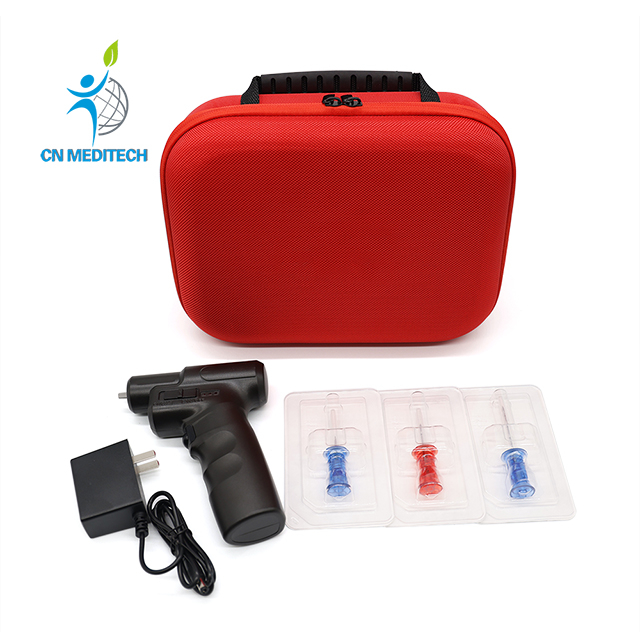
CN MEDITECH's intraosseous device addresses these clinical challenges through its patented dual-bevel needle design that achieves insertion forces 25% lower than industry averages while maintaining push-pull stability. Its variable-speed power driver adapts to bone density variance, reducing over-insertion risk. The system supports flow rates up to 150 mL/min for both crystalloids and blood products, and its battery module provides 6+ hours of continuous operation—sufficient for multiple resuscitation scenarios. With needle sets spanning neonatal to bariatric applications, CN MEDITECH offers a unified solution for emergency infusion device needs.