- All
- Product Name
- Product Keyword
- Product Model
- Product Summary
- Product Description
- Multi Field Search
- Home
- About Us
- Products
- Customer Services
- MEDICAL INFOR
- Contact Us
 |


| Quantity: | |
|---|---|
CNME080104-1
CNMEDITECH
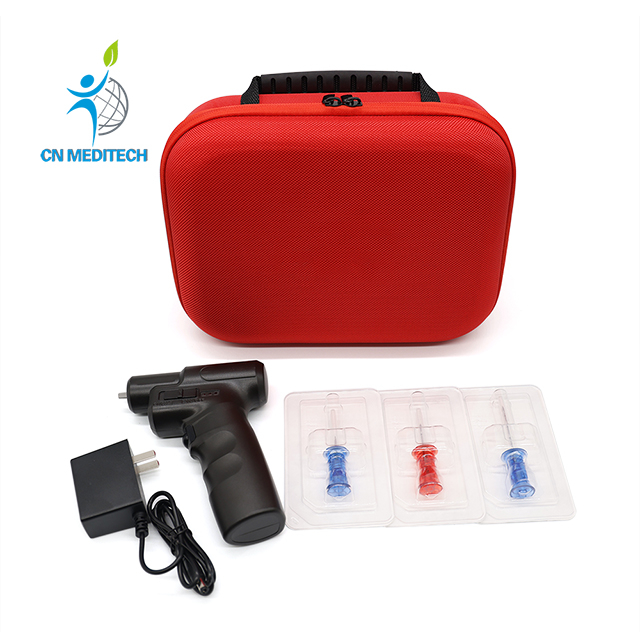
Intraosseous Infusion System Intraosseous Needle

Description:
Intraosseous (IO) infusion is a technique used in emergency and critical care settings to rapidly deliver fluids, medications, or blood products directly into the bone marrow when intravenous (IV) access is difficult or delayed.
The medullary cavity of bones acts as a non-collapsible venous system, allowing for fast absorption into the central circulation.
IO access is typically used in life-threatening situations when IV access is not readily available, such as:
*Cardiac arrest: when rapid drug administration (e.g., epinephrine) is needed.
*Severe shock/hypovolemia: in cases of massive blood loss, sepsis, or dehydration.
*Trauma patients: when veins are collapsed due to haemorrhage or burns.
*Paediatric emergencies: small or difficult-to-access veins make IV insertion challenging.
*Rescue and prehospital care: used by paramedics in the field for critically ill patients.
CN MEDITECH Systems How Does It Work?
Special needles in 3 sizes are driven through skin, SQ, and through cortical base into intrasseous space
A magnet in the driver head holds the needle in place while placement is done
A lithium battery-powered driver can be used over 1000 times
Features:
*The intraosseous vascular system can be readily accessed via key anatomical points such as tibial crest of femural trochanter head
*Easy to use in large and very small patients
*Deliver any drug or fluid that can be IV administered
*No sedation required
Surgical technique:
*Identify the insertion site. The preferred site for intraosseous infusion in children under 6 years of age is the anteromedial surface of the proximal tibia, just below the tibial tuberosity. Other suitable sites include the distal tibia (1–2 cm above the medial malleolus in older children and adults), the distal femur, and the proximal humerus.
*Disinfect the skin and apply local anaesthesia if time permits.
*Stabilize the limb and insert the CN MEDITECH needle.
*Advance the needle with controlled pressure and rotation until a sudden loss of resistance is felt, indicating entry into the medullary cavity.
*Remove the stylet.
*Attach an appropriate syringe to the Luer-lock cone and begin administration of fluids as required.
Photos: